
A worker who can describe a fire evacuation procedure in a classroom may still hesitate when an alarm sounds and the usual exit appears blocked. Virtual reality (VR) safety training gives employees a place to practise that decision. An instructor can observe what the worker notices, discuss the response, and repeat the scenario without exposing anyone to smoke or fire.
For an organization choosing a VR safety training company in India, the starting point is the workplace decision employees need to practice. That decision helps determine what the simulation should include, what the instructor should assess, and which skills still need hands-on practice.
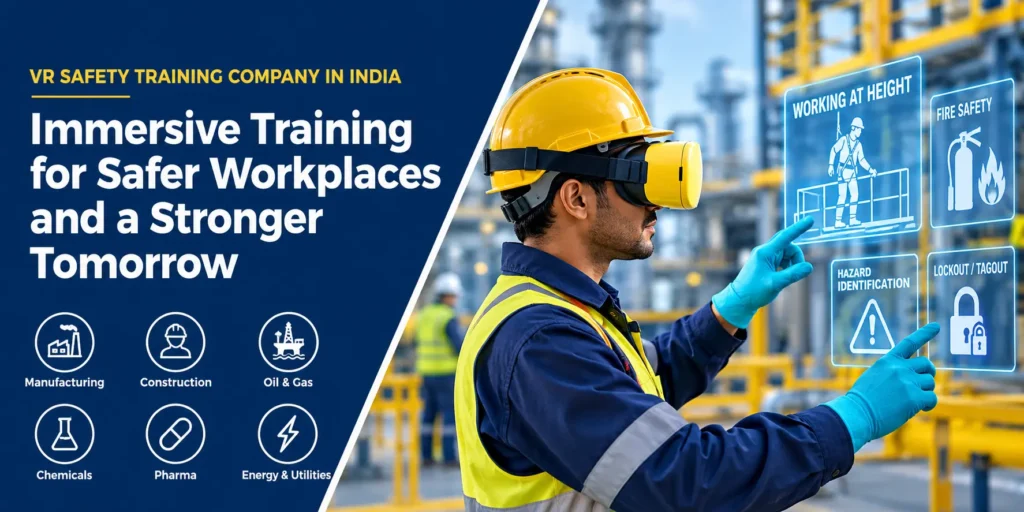
What Is VR Safety Training?
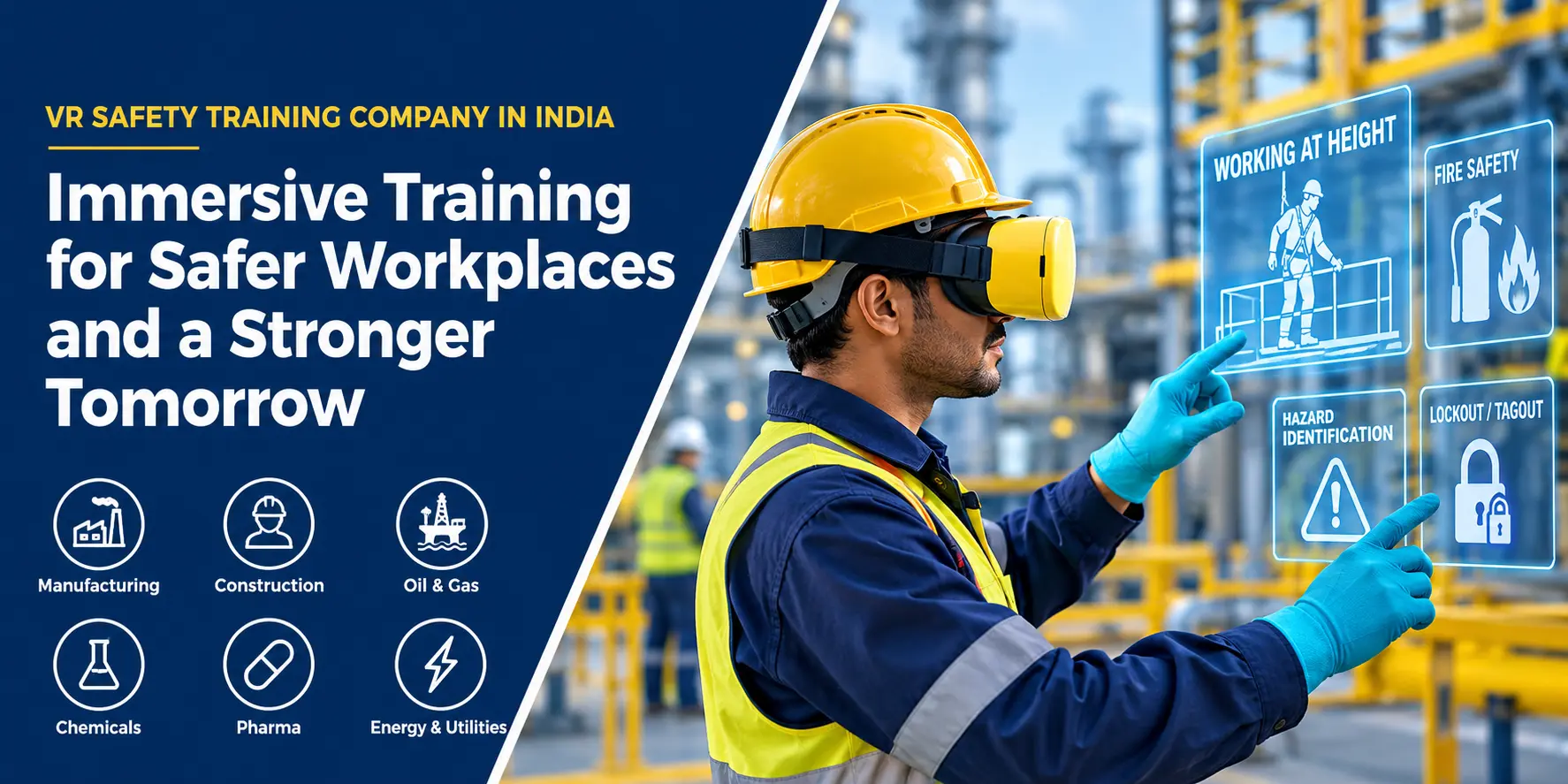
VR safety training uses computer-generated environments to recreate workplace tasks, hazards and emergencies. Participants typically wear a headset that lets them look around a three-dimensional workplace, interact with equipment and make decisions as a scenario unfolds.
For example, a maintenance worker might inspect a simulated machine and identify an unsafe condition before starting a task. The instructor can then discuss which warning signs the worker recognised and which ones they missed.
Industrial VR training can cover:
- Fire safety and emergency response
- Working at height
- Confined space entry
- Electrical safety and hazard identification
- Lockout/tagout (LOTO) awareness
- Chemical handling and spill response
- Construction site safety
- Industrial equipment safety
Why Indian Industries Are Exploring VR Safety Training
Manufacturing plants, construction sites, chemical facilities and energy operations all face a practical training challenge. Employees need to recognise hazardous conditions, yet some of the most important events to prepare for are unsafe to recreate in person.
1. Practical exposure to hazardous situations
An electrical arc flash or a serious chemical release would put trainees at risk in a live demonstration. A simulation can show the warning signs, give employees time to make a decision and let an instructor review the consequences with them.
2. Improved employee engagement
During a presentation, an instructor may have little opportunity to see how each participant interprets a scene. In VR, employees can point out a hazard, choose a response and explain what informed their decision. This gives the instructor something specific to discuss.
3. Consistent training across facilities
A standardised module can give employees at different facilities the same task and learning objectives. Details that affect the correct response, such as alarm signals, evacuation routes and equipment layouts, should reflect the site where employees work.
4. Opportunities for performance assessment
Depending on the software, a VR platform may record which hazards a participant identified, which steps they completed and where they made an error. HSE teams can use these observations to decide who needs further instruction and which parts of a procedure need clarification.
Key Applications of VR Safety Training in Industrial Workplaces
Fire safety and emergency response
A simulated fire can give employees practice recognising an alarm, assessing the conditions around them and choosing an evacuation route under the site’s emergency procedures. During the debrief, the instructor can ask what prompted the employee to act and whether they noticed a change in the route.
Working at height
A virtual platform or scaffold allows employees to look for fall hazards before a task begins. For instance, a trainee can identify an unprotected edge and explain what needs attention before work proceeds. The same scene can be used to discuss how to improve construction site safety during planning and supervision.
Confined space entry
A confined space scenario can ask participants to review the entry permit, identify missing atmospheric testing information and explain the communication arrangements. One useful decision to assess is whether the trainee recognises when entry should be deferred.
Electrical safety training
Employees can practise recognising exposed components, unsafe access and signs of inadequate isolation. A scenario that includes labelled equipment can also help workers learn to read and interpret arc flash hazard labels.
These simulations support workplace instruction. Tasks that require practical demonstrations, supervised assessment or formal competency verification still need those elements.
Benefits of VR Safety Training for Businesses
Better hazard recognition
Employees can inspect a realistic work area before encountering similar conditions on site. Reviewing what a trainee overlooked helps an instructor focus the next exercise on a specific hazard.
Reduced dependence on hazardous demonstrations
Virtual scenarios can illustrate events that would be dangerous or impractical to demonstrate physically. An instructor can pause at a decision point and discuss the available information before showing what happens next.
Repeatable learning opportunities
New employees, contractors and workers attending refresher training can revisit a difficult scenario. A second attempt gives the learner an opportunity to apply feedback while the first decision is still fresh.
Support for training efficiency
Reusable modules may reduce the setup needed for repeated demonstrations. When estimating costs, businesses should account for headsets, licensing, customisation, instructor time, maintenance and updates when site conditions change.
How to Choose a VR Safety Training Company in India
Ask the provider to walk your HSE team through a sample scenario. These six questions can help you judge how well the training fits your workplace.
- Industrial safety expertise. How does the provider use your risk assessments and procedures to decide which hazards and decisions belong in the module?
- Scenario customisation. Can the simulation reflect the equipment, layout and working conditions employees will encounter on site?
- Training objectives. What should a participant be able to recognise, explain or demonstrate after completing the module?
- Assessment capabilities. Can the instructor see which hazard a learner missed or which decision needs further discussion?
- Technical support. What hardware, software maintenance and implementation assistance does the provider offer?
- Integration with existing training. Where does the module fit alongside classroom instruction, practical demonstrations and workplace assessments?
VR Safety Training Solutions by Aura Safety & Risk Consultants
Aura Safety & Risk Consultants combines industrial safety consulting with digital content development in India. Its VR content development services include:
- Customised VR modules and games built around defined learning objectives.
- VR and augmented reality (AR) simulations for training applications.
- Safety animations and videos that illustrate workplace hazards and procedures.
- 2D, 3D and live animation videos for communicating safety information.
- Online safety programmes for workforce learning and communication.
Organisations planning a blended programme can also explore Aura Safety’s HSE Training Academy. Discuss the simulation topic, hardware requirements, delivery arrangements and extent of customisation when defining the project scope.
How to Implement VR Safety Training in Your Organisation
Step 1. Identify training needs
Review your hazard identification and risk assessment findings alongside incident trends, competency requirements and existing training. Select a task where employees would benefit from practising a specific decision.
Step 2. Define learning objectives
State what learners should be able to do after the exercise. For a confined space module, an observable objective is to recognise missing entry information and explain why work should pause.
Step 3. Develop relevant scenarios
Use workplace activities, equipment and foreseeable hazards that employees will recognise. Check that the scenario’s expected response matches the current site procedure.
Step 4. Conduct pilot training
Test the module with a small group. Ask whether the environment resembles their workplace and whether they could understand the instructions and use the controls.
Step 5. Evaluate training effectiveness
Review participant decisions, discuss missed hazards and use knowledge checks or follow-up practical assessments where appropriate. Completing the simulation is only one part of evaluating learning.
Step 6. Review and update content
Revise the module when equipment, layouts, procedures or learning requirements change. A simulation that still shows an old evacuation route can teach the wrong response even if the software works as designed.
Conclusion: Strengthening Industrial Safety Through Immersive Learning
VR safety training is most useful when it gives employees practice with a decision they face at work. Choose one task, define what a good response looks like and pilot the scenario with the people who perform that task. Their decisions and feedback can show where immersive training adds value to your existing HSE programme.
Looking to develop customised VR safety training for your organisation?
Get a quote from Aura Safety to discuss your workplace hazards, training objectives and module requirements.
Frequently Asked Questions About VR Safety Training
What is VR safety training?
VR safety training uses interactive, computer-generated workplaces where employees can identify hazards, practise procedures and make decisions in a controlled environment.
Which industries can benefit from VR safety training in India?
Manufacturing, construction, oil and gas, chemical processing, pharmaceuticals, energy, logistics and infrastructure businesses may benefit. Suitability depends on the hazards employees face and the skills they need to practise.
Is VR safety training better than classroom training?
It depends on the learning objective. A classroom works well for explaining a procedure and answering questions. VR gives employees an opportunity to apply that procedure in a simulated situation. Practical demonstrations and workplace assessments can then address hands-on skills.
Can VR safety training be customised for industrial facilities?
Yes. Modules can represent specific equipment, work areas, hazards and procedures. The extent of customisation depends on the provider’s capabilities, the project scope and the facility information available.
Does VR safety training replace mandatory safety training?
No. VR can supplement a training programme. The organisation remains responsible for meeting the training, supervision and competency requirements that apply to the task.
How much does VR safety training cost in India?
Costs depend on scenario complexity, customisation, participant numbers, headsets, software licensing and implementation support. Request a project-specific quotation that distinguishes initial development costs from recurring charges.