

A HAZOP (Hazard and Operability) study is a structured risk assessment method used to identify process hazards, operational issues, and safety deviations in industrial systems. Widely used across chemical, oil & gas, pharmaceutical, and manufacturing industries, HAZOP helps organizations improve process safety, ensure compliance, and reduce operational risks before incidents occur.
Aura Safety provides HAZOP study and facilitation services for new projects, existing plants, and process modifications across India. Our consultants help clients define the study scope, prepare process nodes, conduct multidisciplinary workshops, and document deviations, causes, consequences, safeguards, and recommended actions.
Whether you are preparing for commissioning, reviewing a process modification or reassessing an operating facility, Aura Safety can help you conduct a structured HAZOP study and produce an actionable study report.
A Hazard and Operability Study (HAZOP) is a structured, qualitative method used as part of a broader process hazard analysis to identify potential hazards and operational problems in new or existing processes and systems.
It helps protect people, equipment, the environment, product quality, and operational continuity.
During a HAZOP, a multidisciplinary team divides the process into manageable sections called nodes. The team applies guide words—such as “No,” “More,” “Less,” “Reverse,” and “Other Than”—to parameters such as flow, pressure, temperature, level, and composition to identify possible deviations.
For each credible deviation, the team evaluates:
IEC 61882 provides internationally recognized guidance for planning, conducting, documenting, and following up a HAZOP study.
A HAZOP study systematically asks, “What could go wrong?” at each stage of a process. It helps identify unsafe deviations before they cause an incident, equipment failure, environmental harm, or operational disruption.
A trained, multidisciplinary team divides the process into manageable sections called nodes. Using Piping and Instrumentation Diagrams (P&IDs) and other relevant documents, the team reviews each node against its intended operation.
Guide words such as No, More, Less, Reverse, and Other Than are applied to process parameters such as flow, pressure, temperature, level, and composition. These combinations help the team identify credible deviations and evaluate their:
A design-stage HAZOP identifies hazards and operability issues while changes can still be incorporated efficiently into the design.
A pre-startup HAZOP, together with a pre-startup safety review (PSSR), helps confirm that credible process deviations, safeguards, and operating requirements have been adequately reviewed before hazardous materials are introduced.
Changes to equipment, chemicals, process conditions, controls, utilities, or procedures may introduce new hazards. A HAZOP can therefore support structured management-of-change reviews
A HAZOP can assess current operating risks, review existing safeguards, and address gaps in previous studies or historical documentation.
A previous HAZOP should be reassessed following significant modifications, incidents, operational experience, or changes in process knowledge.
Aura Safety delivers end-to-end HAZOP support—from study preparation and workshop facilitation to reporting and recommendation close-out.
Our services include:
Each scope is tailored to the process, project stage, available documentation, and required deliverables.
A HAZOP study follows a structured process to identify deviations, evaluate risks, document safeguards, and develop actionable recommendations.
Establish the study objectives, process boundaries, exclusions, assumptions, project stage, responsibilities, and required deliverables.
Review current P&IDs, process data, procedures, and supporting documents. Identify missing or inconsistent information before the workshop begins.
Divide the process into logical sections, such as pipelines, vessels, pumps, reactors, heat exchangers, or control systems. Define a clear design intent for each node.
Combine relevant guide words with process parameters to generate deviations such as no flow, high pressure, low temperature, reverse flow, or incorrect composition.
Determine credible causes for each deviation and assess the potential effects on people, the environment, assets, product quality, and operations.
Identify and assess alarms, interlocks, relief systems, process controls, operating procedures, and other protective measures.
Record clear, actionable recommendations when additional protection, information, or assessment is required. Assign action owners and target dates where possible.
Prepare a structured report containing the study basis, team details, completed worksheets, risk rankings, findings, recommendations, and consolidated action register.
Guide words are combined with relevant process parameters to identify deviations from the intended design or operation.
Guide word | Meaning | Example deviation |
No/None | Intended function does not occur | No flow |
More | Quantitative increase | High pressure |
Less | Quantitative decrease | Low temperature |
Reverse | Opposite direction or sequence | Reverse flow |
Other Than | Complete substitution | Incorrect composition |
As Well As | Additional material or activity | Contamination in feed |
Part Of | Only part of the intended function occurs. | Incomplete reaction |
Only combinations relevant to the node should be assessed. Additional guide words or process-specific prompts may be used where appropriate.
This simplified example shows how a process deviation may be documented during a HAZOP workshop.
Field | Example |
Scenario reference | HZ-01 |
Node | Feed line to process vessel |
Design intent | Transfer feed at the specified flow and pressure. |
Deviation | No flow |
Possible causes | Pump failure, closed valve, or blocked line |
Possible consequences | Loss of feed, process interruption, abnormal vessel conditions, or increased upstream pressure |
Existing safeguards | Flow indication and low-flow alarm |
Risk ranking | Assessed using the client-approved methodology |
Recommendation | Review the adequacy of low-flow protection and implement additional safeguards if required |
Action owner | Assigned by the client |
Target date | Agreed during action close-out |
Status | Open |
Important: This example is illustrative only. Actual causes, consequences, safeguards, and risk rankings must be determined through a project-specific HAZOP study.
A checklist supports preparation and documentation control but does not replace the multidisciplinary, guide-word-based HAZOP examination.
Document requirements vary by process and project stage. Clients should normally provide:
Outdated or incomplete information can delay the workshop and affect study quality. Document readiness should therefore be confirmed before scheduling the HAZOP.
A HAZOP requires a multidisciplinary team with relevant technical and operational knowledge.
Team member | Primary responsibility |
HAZOP facilitator | Leads the examination and maintains the methodology |
Scribe | Records deviations, causes, consequences, safeguards, and actions |
Process engineer | Explains the process design and operating parameters |
Operations representative | Provides practical operating experience |
Instrumentation and control engineer | Reviews controls, alarms, trips, and interlocks |
Mechanical or maintenance representative | Advises on equipment integrity, reliability, and maintenance |
Process-safety specialist | Supports hazard identification and risk evaluation |
Project or design representative | Clarifies design decisions, changes, and interfaces |
Team composition should reflect the process being reviewed. Participants must have sufficient knowledge and authority to contribute effectively.
Depending on the agreed scope, the final deliverables may include:
The report format, submission requirements, and action-tracking process should be agreed upon during project scoping.
HAZOP is widely used in facilities involving hazardous substances, complex processes, stored energy, critical controls, or significant operational risks.
Aura Safety supports process and industrial facilities across India, including:
Method | Primary purpose | Typical application |
HAZID | Broadly identifies major hazards | Concept development and early design |
HAZOP | Examines process deviations in detail | Detailed design, modifications, and operating plants |
LOPA | Assesses whether protection layers adequately reduce scenario risk | Higher-risk scenarios identified by a hazard study |
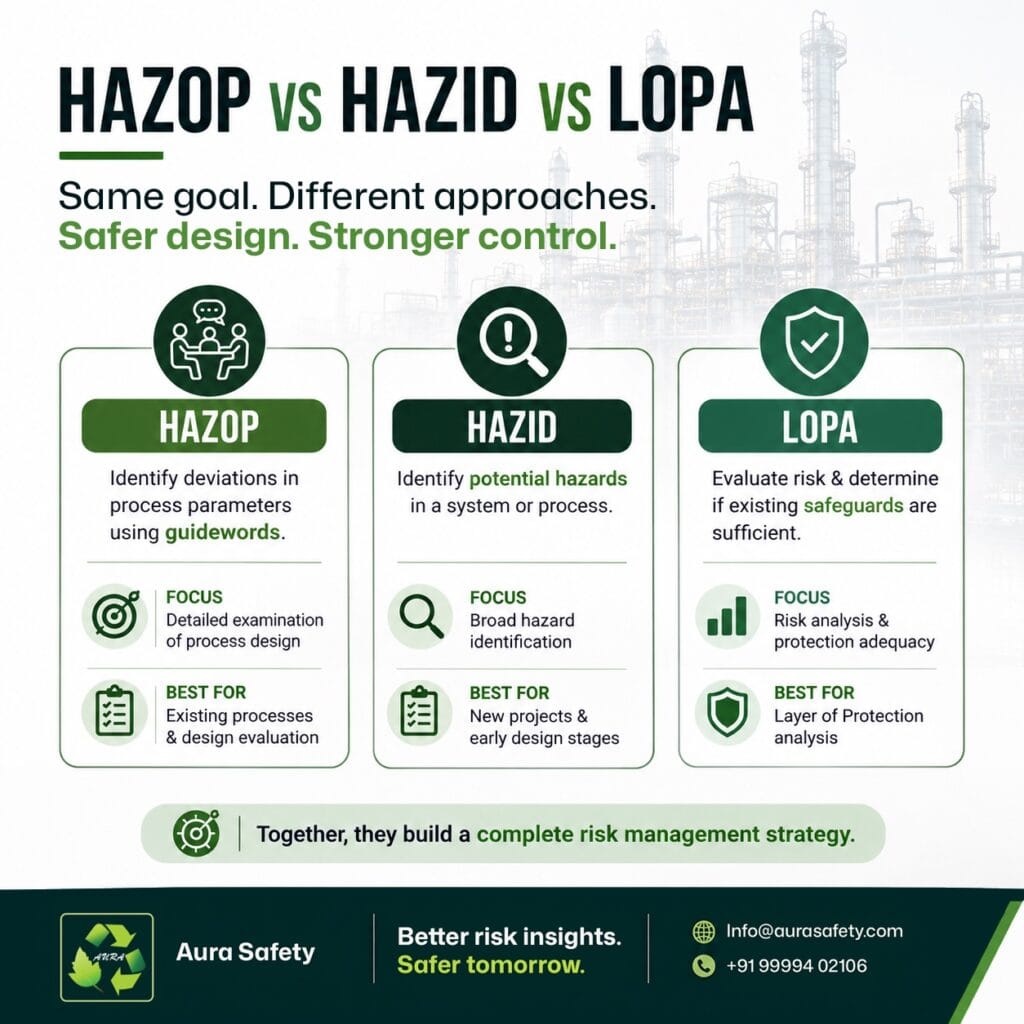
These methods are complementary rather than interchangeable, as are related assessments such as QRA, HAZOP, and SIL studies.
The appropriate study depends on the project stage, available information, process complexity, and decisions to be supported; understanding the differences between HIRA and HAZOP can also help organizations select the right assessment method.
Aura Safety provides end-to-end HAZOP support—from initial scoping and document review to workshop facilitation, reporting, and action tracking.
Clients benefit from:
Before work begins, the proposal clearly defines the required inputs, study approach, responsibilities, schedule, and deliverables.
+91 99994 02106
India-Wide HAZOP Consulting
Discuss your process, project stage, available documentation and required schedule before finalizing the study scope.
A HAZOP is a structured, team-based examination used to identify process hazards and operating problems. The team divides the process into nodes and applies guide words to process parameters to identify deviations, causes, consequences, safeguards, and required actions.
A HAZOP is commonly conducted during detailed engineering, before commissioning, following a significant process modification, or when reviewing an existing plant. Previous studies may also require periodic revalidation.
The team normally includes a facilitator, scribe, process engineer, operations representative, and relevant specialists from instrumentation, mechanical, maintenance, project, and process-safety disciplines. Team composition should reflect the process and hazards being examined.
Typical inputs include current P&IDs, process flow diagrams, design data, equipment information, control and shutdown philosophies, operating procedures, chemical hazard data, and the approved risk matrix. Exact requirements depend on the project stage and study scope.
Deliverables generally include completed HAZOP worksheets, the study basis, team and document lists, identified causes and consequences, existing safeguards, risk rankings, recommendations, and a consolidated action register.
Common guide words include "no," "more," "less," "reverse," "other than," "as well as," and "part of." They are combined with relevant parameters—such as flow, pressure, temperature, level, or composition—to generate possible deviations.
Examples include no flow, high pressure, low temperature, reverse flow, high level, loss of containment, and incorrect composition. The applicable deviations depend on the node’s design intent and operating conditions.
HAZOP examines process deviations in detail, while LOPA evaluates whether independent protection layers—including safeguards associated with a defined safety integrity level (SIL) adequately reduce the risk of selected scenarios.
The duration depends on process complexity, the number and quality of P&IDs, node selection, team availability, and workshop hours per day. The expected duration should be established after reviewing the study scope and available documents.
Yes. Remote HAZOP workshops can be effective when participants have access to current documents, reliable collaboration tools, and a structured facilitation process. Onsite sessions may be preferable for complex facilities or when direct plant knowledge is essential.
Common problems include an unclear scope, outdated drawings, poorly defined nodes, missing disciplines, inconsistent risk ranking, vague recommendations, and inadequate action follow-up. Proper preparation and experienced facilitation help prevent these issues.
Revalidation should be considered after significant modifications, incidents, changes in operating conditions, or new process-safety information. It may also be performed periodically according to applicable regulations, company standards, and risk-management procedures.
HAZOP is widely used in chemical, petrochemical, oil and gas, pharmaceutical, power, food-processing, bulk-storage, and other industries involving complex processes or hazardous materials.