

A Hazard and Operability Study (HAZOP) is intended to systematically examine a process or operation, identify credible deviations from design intent, evaluate their potential causes and consequences, and review the safeguards available to control the associated risks.
But completing a HAZOP does not automatically mean every important hazard has been identified.
The quality of the study depends heavily on the information available, how the system is divided into nodes, the deviations considered, the experience and participation of the study team, the quality of safeguard evaluation, and what happens to recommendations after the workshop.
When these elements are weak, a HAZOP can create a dangerous gap between having completed a study and actually understanding and managing process risk.
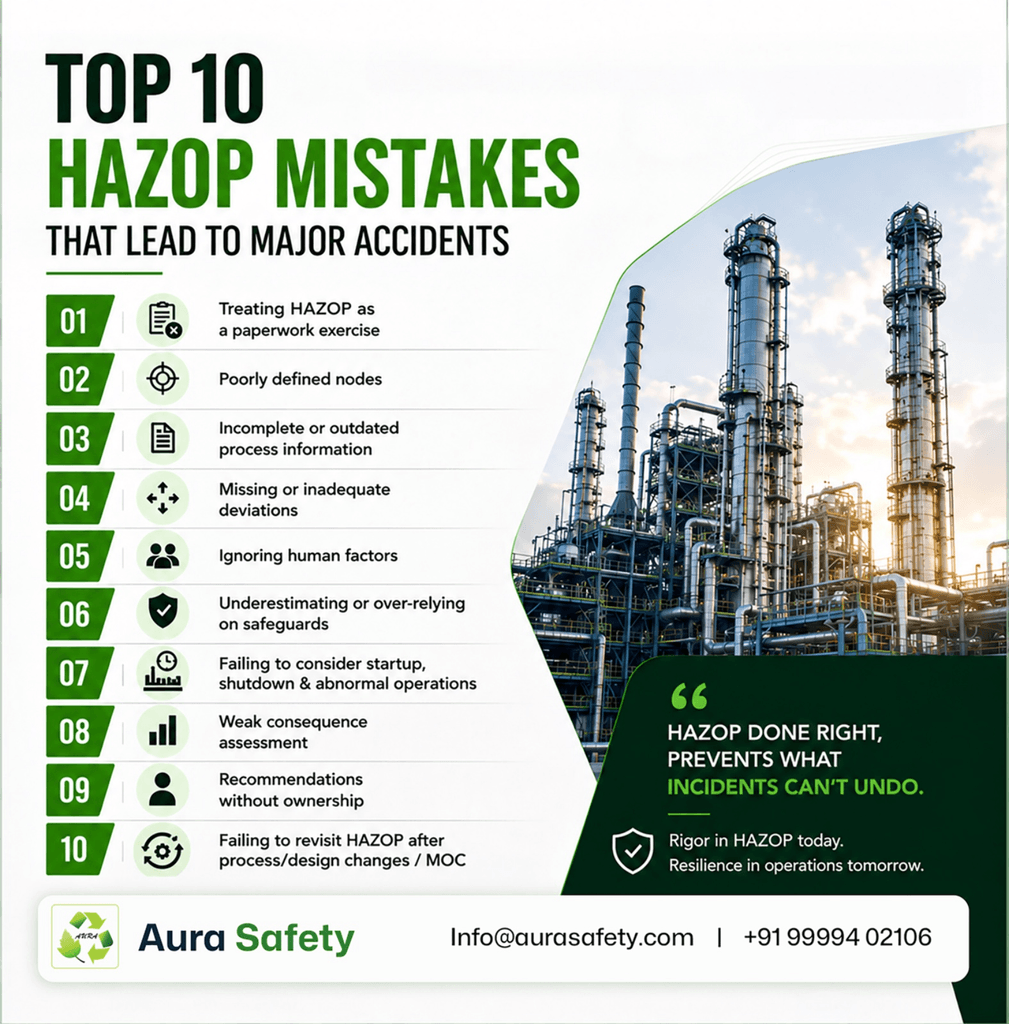
The infographic supplied for this article highlights ten recurring mistakes that can undermine a HAZOP. Below, we examine each one and explain how organizations can strengthen their approach.
1. Treating HAZOP as a Paperwork Exercise
One of the most fundamental mistakes is approaching HAZOP primarily as a document that needs to be completed.
The purpose of a HAZOP workshop is not simply to populate worksheets or satisfy a project milestone. It is to encourage a multidisciplinary team to systematically challenge the design and operating philosophy.
Questions such as these matter:
- What can deviate from the intended operating condition?
- What could cause that deviation?
- What could happen as a result?
- What safeguards are actually available?
- Are those safeguards adequate for the scenario being discussed?
When the emphasis shifts from critical examination to completing documentation quickly, important scenarios may receive insufficient attention.
Better approach: Treat HAZOP as a structured risk-identification exercise in which the quality of discussion and engineering judgement matters as much as the final report.
2. Poorly Defined HAZOP Nodes
Breaking a process into suitable nodes is a fundamental part of HAZOP preparation.
A node should provide the team with a practical boundary within which design intent, process parameters and deviations can be examined systematically.
Nodes that are too broad can make discussions difficult to control. Different equipment, operating conditions and hazards may become mixed together, increasing the possibility that scenarios are overlooked.
Excessively narrow nodes can create the opposite problem: unnecessary repetition, longer workshops and loss of focus.
Better approach: Define nodes before the workshop using current P&IDs and a clear understanding of process functionality and design intent. Node boundaries should support focused analysis without unnecessarily fragmenting the system.
3. Using Incomplete or Outdated Process Information
A HAZOP can only be as reliable as the information available to the team.
If P&IDs, process descriptions, equipment information, control philosophies, operating parameters or other relevant engineering documents do not represent the design being reviewed, the team may analyze conditions that no longer reflect the actual facility or project.
This becomes particularly important in operating plants where modifications may have accumulated over time.
Better approach: Establish the required HAZOP documentation before the workshop and verify that the information reflects the applicable design or current operating configuration.
Where important information is unavailable, assumptions and information gaps should be clearly recorded rather than silently accepted.
4. Missing or Inadequately Exploring Deviations
HAZOP uses systematic questioning to examine deviations from the intended operation of a process.
Simply applying guide words mechanically, however, does not guarantee a complete analysis.
The team must determine whether each resulting deviation is meaningful for the node and whether additional credible operating deviations require consideration.
A superficial discussion may identify obvious scenarios while missing combinations of equipment failures, control failures, utility interruptions or operating conditions.
Better approach: Apply guide words systematically, but use them as prompts for engineering analysis rather than as a checklist to complete.
The objective is to identify credible deviations, understand their causes and follow their consequences logically.
5. Ignoring Human Factors
Not every hazardous deviation originates from equipment failure.
Operators start and stop equipment, respond to alarms, line up valves, isolate systems, perform maintenance and intervene during abnormal situations. These interactions can influence how a process behaves.
A HAZOP that focuses only on mechanical and instrumentation failures may therefore miss credible scenarios involving human interaction with the system.
Examples worth examining may include incorrect valve positioning, inappropriate response to an abnormal condition, procedural errors or unclear operating instructions.
Better approach: Include operations and maintenance perspectives in HAZOP discussions and examine realistic human interactions with the process.
6. Underestimating—or Over-Relying on—Safeguards
Safeguards are central to HAZOP discussions, but they require careful evaluation.
One mistake is assuming a protection layer will work simply because it appears on a drawing. Another is overlooking an existing protection measure that materially affects the scenario.
Teams should understand what each safeguard does, what initiates it and whether it is relevant to the specific cause-consequence pathway being discussed.
Multiple safeguards should also not automatically be treated as independent merely because they have different names.
Better approach: Describe safeguards precisely and evaluate their relevance to the scenario rather than relying on generic statements such as “alarm provided” or “operator action.”
Where further risk analysis is required, HAZOP findings can provide input to a Safety Integrity Level (SIL) assessment. They may also support a Quantitative Risk Assessment (QRA) or Bow-Tie Analysis.
7. Failing to Consider Startup, Shutdown and Abnormal Operations
Normal operation represents only part of a facility’s risk profile.
Startup, shutdown, maintenance preparation, utility failure, emergency conditions and other non-routine operating states can introduce different process configurations and operating challenges.
Equipment that normally remains isolated may enter service. Automatic controls may operate differently. Temporary line-ups may be required. Operators may also need to perform several tasks within a short period.
A HAZOP focused only on steady-state production can therefore leave important scenarios insufficiently examined.
Better approach: Explicitly determine which operating modes are relevant to the study and assess credible deviations associated with startup, shutdown and abnormal conditions.
A Pre-Start-Up Safety Review (PSSR) can also play an important role before startup by verifying readiness following relevant projects or modifications.
8. Weak Consequence Assessment
Identifying a deviation is only the beginning. The team must also understand what could reasonably happen if that deviation occurs.
Weak consequence descriptions such as “unsafe condition,” “equipment damage” or “process upset” provide limited information for risk-based decision-making.
The team should trace the scenario far enough to understand credible outcomes and escalation pathways.
Depending on the process, consequences could involve loss of containment, fire, explosion, toxic exposure, equipment damage, production interruption or effects on personnel.
Better approach: Write consequence descriptions that clearly communicate the credible outcome of the scenario and provide enough information for subsequent risk evaluation.
Where a scenario requires more detailed evaluation, techniques such as Failure Mode and Effects Analysis (FMEA) may be appropriate. A Bow-Tie Analysis can also help examine threats, consequences and the barriers intended to prevent or mitigate an event.
9. Creating Recommendations Without Clear Ownership
Even a technically strong HAZOP loses value when its recommendations remain unresolved.
Recommendations may require engineering changes, additional analysis, operating-procedure updates, instrumentation review or further verification. Without clear accountability, actions can remain open while the underlying concern continues to exist.
Every recommendation therefore needs an effective management process after the workshop.
Better approach: Establish an action-tracking process that records the recommendation, responsible owner, required response and closure status.
Closure should mean that the concern has been appropriately addressed and documented—not simply removed from an action list.
10. Failing to Revisit HAZOP After Process or Design Changes
A HAZOP represents the system and information reviewed at a particular point in time.
Facilities and projects change.
Equipment may be replaced. Process conditions may change. New chemicals may be introduced. Control philosophies can be modified. Production capacity can increase. Piping configurations may also change.
If these changes affect assumptions or scenarios considered during the original HAZOP, the previous analysis may no longer fully represent the current risk profile.
This is where Management of Change (MOC) reviews become particularly important.
Better approach: Integrate HAZOP review with the organization’s change-management process so that relevant modifications trigger appropriate risk assessment and, where necessary, revalidation or additional HAZOP analysis.
What Makes a HAZOP Study Effective?
Avoiding these ten mistakes comes down to one principle: HAZOP quality depends on the rigor of the process, not simply the existence of the report.
An effective study requires appropriate preparation, reliable process information, sensible node selection, systematic examination of deviations, multidisciplinary participation and careful consideration of causes, consequences and safeguards.
Equally important is what happens after the workshop. Recommendations need to be tracked, design changes need to be managed, and the study should remain connected to the wider process safety lifecycle.
HAZOP should therefore not operate in isolation. Depending on the facility and identified hazards, its findings may connect with other risk-management activities such as HAZID, QRA, SIL, PSSR, FMEA, Bow-Tie Analysis, FERA and MOC Reviews within a broader process safety services framework.
For a broader introduction to the methodology, explore Aura Safety’s HAZOP study guide.
HAZOP Study Support from Aura Safety
Aura Safety & Risk Consultants provides HAZOP Study services as part of its broader Process Safety offering.
For organizations planning a new HAZOP, reviewing an existing study or addressing process changes that require further risk evaluation, a structured approach can help improve hazard identification, strengthen decision-making and provide clearer visibility of unresolved process risks.
Need support with a HAZOP Study?
Discuss your facility, project scope and process safety requirements with Aura Safety & Risk Consultants.
Get a Quote
Frequently Asked Questions
What is the most common mistake during a HAZOP study?
There is no single mistake that applies to every study. However, treating HAZOP as a paperwork exercise can undermine the entire process because it encourages teams to focus on completing worksheets rather than critically examining credible deviations, causes, consequences and safeguards.
Why is node selection important in HAZOP?
Nodes establish the sections of the process examined during the study. Poorly selected nodes can make analysis either too broad or unnecessarily fragmented, reducing the efficiency and clarity of the workshop.
Should startup and shutdown be included in a HAZOP?
Where startup, shutdown or other operating modes create credible deviations or different process conditions, they should be appropriately considered within the risk review.
When should a HAZOP be reviewed after a plant modification?
Changes that affect the process, equipment, operating conditions, controls or assumptions underlying an existing HAZOP should be evaluated through the organization’s change-management process to determine whether further HAZOP review or another risk assessment is required.
What happens to HAZOP recommendations after the workshop?
Recommendations should enter a documented action-management process with clear responsibility and appropriate follow-up. Effective closure should demonstrate that the concern identified during the study has been adequately addressed.